Wednesday, July 11, 2007

Angola Flotilla

Float McCoy, in a steam storm, once lost himself.
When he managed to levitate out of the hot mess, he ventured to find himself once again.
60 years in a cave yielded results.
He felt his salvation in the logical law of identity.
He had a pair of specially etched spectacles made to forever remind him that:

A=A.

Unfortunately, he failed to take into account the fact that, whenever wearing the spectacles he never takes off, he sees the law backwards: A=A.

And so, he wreaks havoc with his steam fleet that isn't what it is.

Tall scaffold


Few nights ago, I saw a movie in a beautiful building.
The ticket booth was a wall and a stainless steel porthole with a video screen.
On the video screen was a person manning the booth.

This was way too strange for me. I opted to use a real machine to buy my ticket.
And that was no problem.

It's funny though, there was a man there who had really serious trouble understanding the automated ticket machine dispenser, but later on, I saw him chatting with the person in the video porthole very casually.

Monday, July 09, 2007

Hungarian Hyperinflation


It is estimated that the total weight of gold people have mined over the years is around 125 000 tonnes. If it were stacked, it would reach dimensions of 18m x 36m x 9m.

This massive stack of gold though, would still be worth less than the currency currently circulating the United States alone given the price of gold above.
If things got really crazy and people decided to move back to the gold standard for stability sake or something silly, it would have to be done in conjunction with a fractional-reserve policy. That is to say: banks would have to constantly loan out far more than they kept in reserves, which is something they do already.


But in Canada that hasn't been a concern since 1991.
Canada has adopted a Zero-Reserves Banking System!


I don't even understand how that's possible.

Dead Metal


I read about money all night.
I'm very confused.

At this point, I have come to find that there are three different kinds of money.

There is commodity money.
This is something that is a commercial commodity as well as a medium of exchange.
Historically, precious metals like gold and silver has been used as commodity money in addition to things like grain and livestock. In the 1800s most Industrial nations held to a gold standard. The gold standard saw to it that all bank notes produced were backed by gold and could be exchanged at any time for the gold they represented from the issuer of the note.

So far so good.
There was a time when bank notes represented actual stockpiles of commodities.
And if you wanted commodities instead of pieces of paper, you could demand them.

Now there's fiat money.
I'm still having great difficulty accepting this.
I was always pretty sure money was a very strange concept
but I really had no idea. It seems that fiat currency really has no basis in reality. Its value is absolutely dependent on its own legality. It's a government's promise. If at any time a people's confidence supporting a legal system backing a fiat currency collapses, so too will the currency. The gold standard got too silly, it just couldn't keep up and ultimately, there just isn't enough of it aboveground to reasonably ensure a complete currency backing. The gold standard has been largely ignored by the world since 1971.

Every nation in the world currently produces fiat currency.

Arbitrarily!

The third type of money seems to make the littlest sense of all.
I wouldn't dare pretend I understand any underlying principle to it and I'd run from anyone who thought they did. From what I understand, credit money is future money. Banks create it when they're feeling optimistic and approving loans.

The most bizarre thing I have discovered is that this particular form of money has vastly overtaken both commodity money and fiat money in terms of abundance and activity in the global economy. A majority of the money we are exchanging for goods and services is credit money! Future money that does not exist yet!

Madness!


Anyway, have a nice Monday.


Colouring book


Another

Saturday, July 07, 2007

Undersea Fault


In 1931, Alice's adventures in Wonderland was banned in the Hunan Province of China because "Animals should not use human language."


Friday, July 06, 2007

Tin rubbish

We
Could
Recycle
The neon
waste from the
São Paulo advertisement ban
- - - - - - - - - - - - - - - - - - - - - - - - - - - - - - - - -
- - - - - - - - - - - - - - - - - - - - - - - - - - - - - - - - -
- - - - - - - - - - - - - - - - - - - - - - - - - - - - - - - - -


It could be very hip

Thursday, July 05, 2007

Good morning, Favela.


Like in Ancient Greece, city councilors in São Paulo took part in the sacred and confusing procedure of Ostracism earlier this year.
Much like the Ancient Greeks, Forty Six São Paulo city councilors looked around quite nervously and asked themselves in a room without cameras whether or not they should like to find something guilty among them.
The unanimous opinion was in the affirmative.
"Oh yes, something must take the fall."


Keeping to Greek tradition, the city councilors etched names into broken pottery. These names belonged to things they thought were quite deserving of blame and expulsion from society.


Tallying the votes, it was found that forty five of the forty six councilors felt that advertisements needed to be removed from their large city. (It must be noted that the forty sixth councilor was also an advertising executive.)

And so, on January first, or some other date,
Advertisements were rounded up and expelled from the city of São Paulo.

This city of 11 million people, one of the largest cities in the world, is a city without advertising.

For years, the advertisements in São Paulo not only propagated the hyperreal but physically obstructed the real. Billboards stretched across the tops of highway interchanges and advertising agencies would often offer cash settlements to poor homeowners for rights on their gardens or walls. With the advertisements gone, the rusted out structures that formerly housed them now stand as frames for the backgrounds they had masked.

The cascading favelas of São Paulo sprawl naked now!
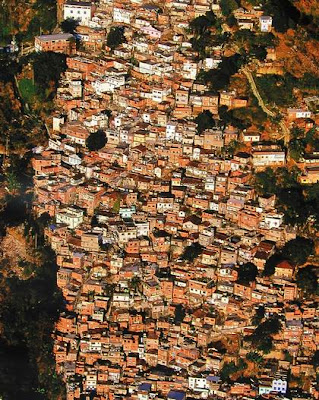


A photographer has been taking pictures of São Paulo's
billboard graveyards. The first photograph is his.
The rest of his photos can be found here